
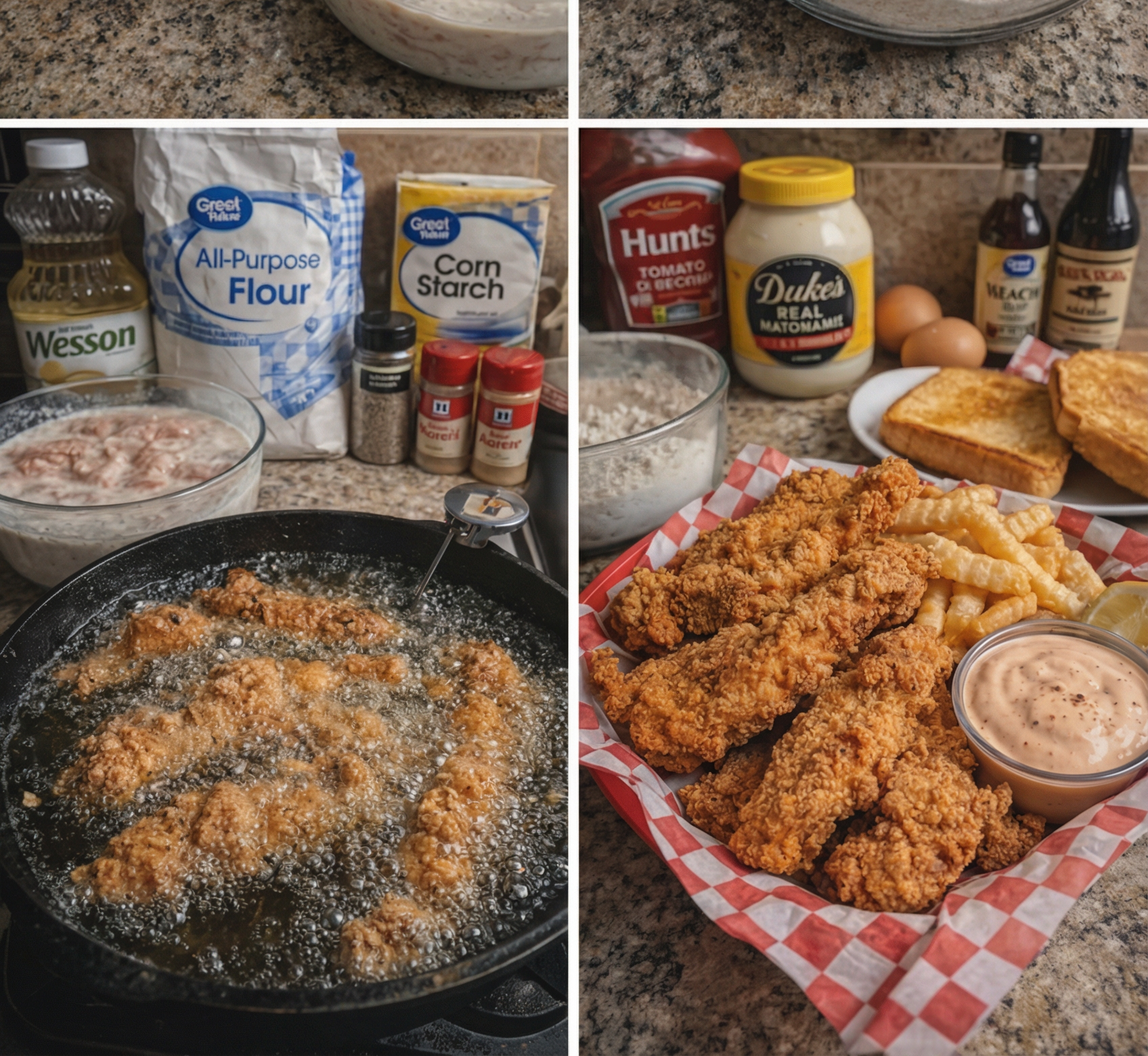
If you’ve ever stood in line at Raising Cane’s just for
those perfectly crispy chicken strips and that addictive
dipping sauce, you already know this recipe is worth making.
This Ultimate Cane’s Copycat delivers everything you love
about the original — the golden crunch, the juicy interior,
and that iconic sauce — made entirely from scratch in your
own kitchen. The best part? Once you master this recipe, you’ll realize
you can make it better, fresher, and more generously portioned
than any restaurant visit. Let’s break it all down.Raising Cane’s built an empire on one thing: doing chicken
strips better than anyone else. No burgers, no salads,
no distractions — just perfectly seasoned, buttermilk-marinated
chicken strips fried to golden perfection, served with
their legendary Cane’s sauce.
The genius is in the simplicity. Every element — the marinade,
the coating, the sauce — is carefully balanced to create
a flavor profile that’s somehow greater than the sum of its parts.
This copycat recipe reverse-engineers every single layer
of that experience, from the double-dip breading technique
to the spot-on sauce recipe.
The Secret: Buttermilk Marinade
The single most important step in this entire recipe
is the buttermilk marinade — and skipping it or rushing it
is the number one mistake home cooks make.
Here’s why it matters:
Buttermilk is mildly acidic, which means it gently breaks
down the protein fibers in the chicken without making it mushy.
The result is chicken that is deeply tender, incredibly moist,
and infused with flavor all the way through — not just on the surface.
The garlic powder, paprika, black pepper, and salt in the
wet marinade penetrate the chicken during the chill time,
building a flavor foundation that no amount of surface
seasoning can replicate.
Minimum chill time: 2 hours.
Ideal chill time: overnight.
If you have the time, always go overnight. The difference
in tenderness is remarkable and immediately noticeable.
Complete Ingredients Breakdown
For the Chicken:
2 lb chicken breast strips — cut to uniform size for
even cooking. Uniform strips mean every piece finishes
at the same time, with no undercooked centers
or overcooked edges.
Oil for frying — use a neutral oil with a high smoke point.
Vegetable oil, canola oil, or peanut oil all work perfectly.
Peanut oil, in particular, produces an exceptionally
clean, crispy result.
For the Wet Marinade:
2 cups buttermilk — the tenderizing base
2 tbsp garlic powder — deep, savory backbone
1 tbsp black pepper — warmth and bite
1 tbsp paprika — color and mild smokiness
Salt to taste — essential for seasoning the meat itself
For the Dry Coating:
2 cups all-purpose flour — the primary coating structure
3 tbsp cornstarch — the secret to extra crunch.
Cornstarch inhibits gluten development and creates
a lighter, crispier crust that holds up even as it cools.
1 tbsp garlic powder — mirrors the wet marinade flavor
1 tsp paprika — color and depth
1 tsp black pepper — consistent seasoning throughout
Salt to taste
For the Legendary Cane’s Sauce:
1 cup mayonnaise — the rich, creamy base
4 tbsp ketchup — sweetness and tang
2 tbsp Worcestershire sauce — the deep, umami secret ingredient
1 tbsp garlic powder — bold and aromatic
1 tsp black pepper — subtle heat
1 tsp paprika — color and warmth
Salt to taste
Step-by-Step Method
Step 1: Make the Buttermilk Marinade
In a large bowl, whisk together the buttermilk,
garlic powder, black pepper, paprika, and salt
until fully combined. The marinade should be
uniformly seasoned with no clumps.
Step 2: Marinate the Chicken
Submerge all chicken strips completely in the buttermilk
marinade. Cover the bowl with plastic wrap and refrigerate
for a minimum of 2 hours — overnight is strongly preferred.
The chicken will absorb the marinade, turning noticeably
more tender and deeply flavored. This is where Cane’s
signature texture is born.
Step 3: Prepare the Dry Coating
In a separate wide, shallow bowl, whisk together
the flour, cornstarch, garlic powder, paprika,
pepper, and salt until evenly blended.
The cornstarch is the key ingredient here —
it’s what separates a good crust from a great one.
Step 4: Dredge the Chicken
Remove chicken strips from the buttermilk one at a time.
Shake off the excess marinade — you want the chicken
damp, not dripping.
Press each strip firmly into the dry coating, turning
to coat all sides completely. Press the coating onto
the chicken with your palm to help it adhere.
Set coated strips on a wire rack and let them rest
for 5 minutes — this helps the coating bond properly
before hitting the oil.
Step 5: Heat the Oil
Pour oil into a heavy-bottomed pot or deep skillet
to a depth of at least 2–3 inches. Heat to 350°F (175°C).
Use a kitchen thermometer for accuracy —
temperature control is critical for proper frying.
Too low: the chicken absorbs oil and becomes greasy.
Too high: the crust burns before the chicken cooks through.
350°F is the exact sweet spot.
Step 6: Fry to Golden Perfection
Carefully lower chicken strips into the hot oil
in small batches — never overcrowd the pot.
Overcrowding drops the oil temperature and produces
steamed, soggy chicken instead of crispy, bronzed strips.
Fry for 4–6 minutes, turning once halfway through,
until each strip is deeply golden brown and cooked
through to an internal temperature of 165°F.
Transfer to a wire rack (never paper towels —
paper traps steam and softens the crust) to drain.
Step 7: Make the Cane’s Sauce
While the chicken fries, combine all sauce ingredients
in a bowl: mayonnaise, ketchup, Worcestershire sauce,
garlic powder, black pepper, paprika, and salt.
Stir until completely smooth and uniform in color.
Pro tip: Make the sauce at least 30 minutes ahead
and refrigerate it. The flavors meld together
dramatically as it chills, and cold sauce against
hot crispy chicken is part of the magic.
Step 8: Serve Immediately
Arrange the hot chicken strips on a platter
alongside a generous bowl of Cane’s sauce.
Serve immediately for maximum crunch.
The Science Behind the Perfect Crunch
Understanding why this recipe works makes you
a better cook across the board:
Cornstarch in the coating: Cornstarch doesn’t develop
gluten the way flour does, which means the crust stays
lighter and shatters cleanly on the first bite rather
than becoming chewy or tough.
Resting after dredging: Letting the coated chicken
sit for 5 minutes before frying gives the flour coating
time to hydrate slightly and grip the surface of the
chicken more firmly — reducing coating falloff in the oil.
Wire rack for draining: Setting fried chicken on a wire rack
allows hot air to circulate underneath, keeping the bottom
crust just as crispy as the top. Paper towels create steam
that softens the crust from the bottom up.
Frying in batches: Every strip added to the oil lowers
the temperature. Small batches maintain the 350°F
sweet spot throughout the cook.
Pro Tips for Restaurant-Quality Results
Pound thick strips slightly: If your chicken breast
strips are uneven in thickness, give the thick end
a gentle pound with a meat mallet. Uniform thickness
means uniform cooking.
Double dredge for extra crust: For an even thicker,
crunchier coating, dip the dredged chicken back into
the buttermilk and then into the flour mixture a second time.
Season every layer: Notice that both the wet marinade
and the dry coating are seasoned. This layered seasoning
is what makes each bite flavorful throughout —
not just on the surface.
Make the sauce ahead: Cane’s sauce tastes significantly
better after resting in the refrigerator for at least
an hour. If possible, make it the night before.
Use a thermometer: Both for the oil temperature
and the internal chicken temperature.
Guessing leads to greasy or undercooked results.
A $10 instant-read thermometer eliminates all uncertainty.
Variations Worth Trying
Spicy Cane’s Strips
Add 1 tbsp hot sauce and 1/2 tsp cayenne pepper
to the buttermilk marinade. Increase paprika in
the dry coating to 2 tsp for extra heat and color.
Air Fryer Version
After dredging, spray chicken generously with
cooking spray on all sides. Air fry at 400°F
for 12–14 minutes, flipping halfway through.
The result is significantly lighter but still
delivers excellent crunch.
Oven-Baked Version
Place dredged strips on a wire rack set over a
baking sheet. Spray generously with cooking spray.
Bake at 425°F for 20–22 minutes, flipping once at
the halfway point. Not quite as crispy as deep-fried
but a solid lighter alternative.
Gluten-Free Version
Replace all-purpose flour with a 1:1 gluten-free
flour blend and ensure your cornstarch is certified
gluten-free. The texture is slightly different
but remains crispy and delicious.
How to Store and Reheat
Storing:
Allow chicken to cool completely before storing.
Place in an airtight container and refrigerate
for up to 3 days.
Store the sauce separately in a sealed jar —
it keeps for up to 1 week refrigerated.
Reheating for maximum crispiness:
Air fryer: 375°F for 4–5 minutes —
this is by far the best reheating method.
The crust comes back almost identical to fresh.
Oven: 400°F on a wire rack for 8–10 minutes.
Microwave: Works but significantly softens the crust.
Use only as a last resort.
Frequently Asked Questions
Can I use chicken tenders instead of cutting breast strips?
Absolutely. Pre-cut chicken tenders work perfectly
and save prep time. Just make sure they’re
similar in size for even cooking.
Can I marinate for less than 2 hours?
You can, but the results won’t be as tender or flavorful.
If you’re truly short on time, even 30 minutes is
better than no marinade at all — but plan for overnight
whenever possible.
What’s the Worcestershire sauce doing in the Cane’s sauce?
Worcestershire adds a deep, savory umami note that you
can’t quite identify but immediately notice when it’s missing.
It’s the ingredient that makes the sauce taste complex
rather than like simple flavored mayo.
Can I make a larger batch of the sauce?
Yes — the sauce recipe scales perfectly.
Double or triple it and store in a sealed jar in the fridge.
It actually tastes better on day two and three
as the flavors continue to develop.
Is this really as good as Raising Cane’s?
Many people who make this recipe say it’s actually better —
fresher chicken, more generous portions, customizable
seasoning, and made exactly to your taste.
The sauce is remarkably close to the original.
Final Thoughts
The Ultimate Cane’s Copycat isn’t just a recipe —
it’s a complete lesson in what makes great fried chicken great.
The buttermilk marinade, the cornstarch-enhanced coating,
the precise frying temperature, and the perfectly balanced
signature sauce all work together to create something
that genuinely rivals — and in many ways surpasses —
the restaurant original.
Make it once and it becomes part of your permanent rotation.
Make the sauce ahead, fry in confident batches,
and serve it hot alongside that cold, creamy,
utterly addictive dipping sauce.
Raising Cane’s built a restaurant empire on this chicken.
Now your kitchen can too.