
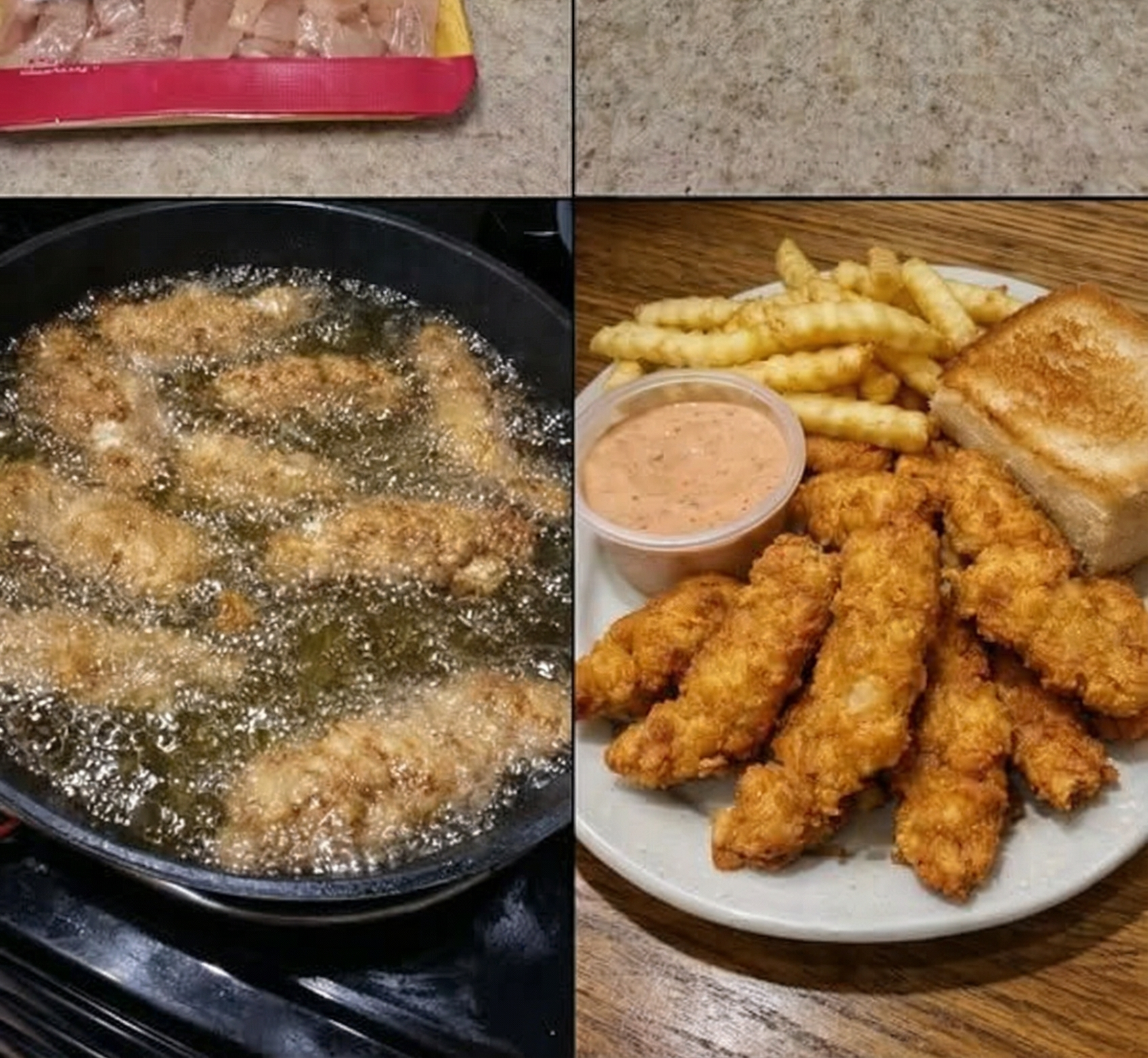
Picture the perfect chicken finger.
Not the frozen kind. Not the soggy kind.
The kind with a crust that shatters
on the very first bite —
giving way to chicken that’s
so juicy and tender it almost
doesn’t seem possible from a home kitchen. That’s exactly what this recipe delivers. Inspired by one of America’s most beloved
fast food chains, these Cane’s Style Chicken Fingers
crack the code on what makes that chicken
so distinctly different from everything else:
the buttermilk marinade that goes deep,
the double-seasoned batter that builds
flavor in every single layer,
and the iconic sauce that ties it
all together in the most addictive way possible. The Secret Is in the Layers Most people think great fried chicken
is about the coating.
It’s not — or at least,
not only about the coating. It’s about what happens before the coating.
The chicken in this recipe spends
a minimum of two hours —
and ideally a full overnight —
submerged in a seasoned buttermilk bath
spiked with smoked paprika,
garlic powder, and black pepper. That time in the marinade does three things
that no amount of surface seasoning can replicate: The mild acidity of the buttermilk
gently restructures the protein fibers
of the chicken — making them
fundamentally more tender before
a single drop of oil gets involved. The seasonings penetrate beyond the surface,
building flavor that exists inside the chicken —
not just on the crust around it. The buttermilk coating that clings to the chicken
when it’s lifted from the marinade
becomes the adhesive layer
that bonds the dry batter to the meat —
creating a crust that stays attached
through the entire frying process. This is the foundation everything else is built on.
Respect it. Don’t rush it. Why Smoked Paprika Changes Everything Regular copycat recipes use standard paprika.
This recipe uses smoked paprika —
and the difference is immediately noticeable. Smoked paprika carries a gentle,
wood-fired depth that regular paprika doesn’t have.
In the wet marinade, it infuses the chicken itself
with a subtle smokiness that reads
as complexity rather than any specific flavor.
In the dry batter, it contributes
to that beautiful deep amber color
on the finished crust —
the kind of golden brown that signals
perfectly fried chicken before you’ve even taken a bite. It appears in both the wet and dry components —
and that doubling is intentional.
Every layer of this recipe is seasoned.
Nothing relies on the layer above or below it.
The result is chicken that tastes
completely seasoned in every single bite,
regardless of which part you’re eating. The Cornstarch Principle The dry batter in this recipe
isn’t just all-purpose flour.
Three tablespoons of cornstarch
are mixed into the flour —
and this small addition
makes a significant difference. Cornstarch doesn’t develop gluten
the way wheat flour does.
When it hits hot oil,
it creates a lighter, more delicate crust
that shatters cleanly rather than
bending or becoming chewy.
It’s the same principle behind
the crispiness in Korean fried chicken
and Japanese tempura —
and it applies just as effectively
to American-style chicken fingers. The ratio here is carefully balanced:
enough cornstarch to dramatically increase crispiness,
not so much that the crust becomes brittle or pale.
Complete Ingredients
For the Chicken:
2 lb chicken breast, cut into uniform strips
Oil for frying — vegetable, canola, or peanut oil
For the Wet Batter:
2 cups buttermilk
2 tbsp garlic powder
1 tbsp smoked paprika
1 tbsp black pepper
Salt to taste
For the Dry Batter:
2 cups all-purpose flour
3 tbsp cornstarch
1 tbsp garlic powder
1 tsp smoked paprika
1 tsp black pepper
Salt to taste
For the Cane’s Sauce:
1 cup mayonnaise
4 tbsp ketchup
2 tbsp Worcestershire sauce
1 tbsp garlic powder
1 tsp smoked paprika
1 tsp black pepper
Salt to taste
The Method, Step by Step
Building the Wet Marinade
Whisk the buttermilk, garlic powder,
smoked paprika, black pepper, and salt
in a large bowl until completely uniform.
Add the chicken strips,
pressing them down to fully submerge.
Cover and refrigerate.
Two hours is the minimum.
Overnight is the goal.
The longer the chicken sits,
the more dramatic the tenderness difference becomes.
Building the Dry Batter
Combine flour, cornstarch, garlic powder,
smoked paprika, black pepper, and salt
in a wide, shallow bowl.
Whisk thoroughly until completely blended —
every handful of this mixture should be
uniformly seasoned and colored.
The Dredging Process
Lift each chicken strip from the buttermilk,
hold it above the bowl,
and let the excess drip off for three to four seconds.
You want the chicken visibly coated —
not dripping wet.
Press each strip firmly into the dry batter,
turning to coat all sides.
Use your palm to press the coating
actively onto the chicken surface —
this pressure creates adhesion
that passive coating never achieves.
Place coated strips on a wire rack
and rest for five minutes
before they touch the oil.
Frying to Golden Perfection
Heat oil in a heavy pot or deep skillet
to exactly 350°F.
A kitchen thermometer is not optional —
it’s the difference between
perfectly fried and imperfectly fried chicken.
Temperature fluctuations of even 25 degrees
produce noticeably different results.
Fry in small batches —
three or four strips maximum at a time.
Each strip added to the oil
drops the temperature of that oil.
Small batches maintain 350°F throughout.
Large batches tank the temperature
and produce greasy, under-crisped results.
Fry for 8 to 10 minutes total,
flipping halfway through,
until each strip is deeply golden
and registers 165°F internally.
Rest on a wire rack — not paper towels.
Wire allows air circulation underneath.
Paper traps steam and softens
the bottom crust immediately.
Making the Sauce
Combine all sauce ingredients in a bowl
and whisk until smooth and completely unified.
The Worcestershire sauce is the element
that makes this sauce taste like
more than just seasoned mayo —
it adds a deep, fermented umami note
that creates genuine complexity.
Don’t skip it and don’t reduce it.
Make the sauce before you start frying
and let it sit in the refrigerator.
Cold sauce against hot crispy chicken
is part of the experience —
and the flavors meld noticeably
after even 30 minutes of chilling.
Temperature and Timing Reference
Marinade time: 2 hours minimum, overnight ideal
Oil temperature: 350°F — maintain throughout
Frying time: 8 to 10 minutes, flip at 4 to 5
Internal temperature: 165°F
Rest time: 3 to 5 minutes on wire rack before serving
Variations
Air Fryer Version
Spray coated strips generously with cooking oil
on all sides. Air fry at 400°F for 12 to 14 minutes,
flipping at the halfway point.
Spray again after flipping for even browning.
Significantly lighter — still excellent crunch.
Extra Spicy Version
Add 1 teaspoon cayenne to the wet marinade
and 1/2 teaspoon to the dry batter.
Increase smoked paprika to 1.5 teaspoons in each.
The heat builds slowly and lingers —
balanced perfectly by the creamy sauce.
Honey Butter Finish
Brush finished strips with a mixture
of 2 tablespoons melted butter
and 1 tablespoon honey immediately out of the oil.
The butter soaks in while the strips are hot —
creating a sweet, rich glaze
over the crispy surface.
Storage and Reheating
Refrigerator: Airtight container, up to 3 days.
Sauce: Sealed jar, up to 1 week.
Reheating for maximum crispiness:
Air fryer at 375°F for 4 to 5 minutes —
produces results remarkably close to fresh.
Oven at 400°F on a wire rack for 8 to 10 minutes.
Avoid the microwave — it destroys the crust completely.
The sauce actually improves over several days
as the flavors continue developing.
Day three sauce is noticeably better than day one.
Final Thoughts
What makes Raising Cane’s chicken special
isn’t magic — it’s discipline.
The commitment to marinating properly,
seasoning every single layer,
maintaining precise oil temperature,
and finishing with a sauce
that was designed specifically
to complement that exact chicken.
This recipe applies that same discipline
in your kitchen — with fresher chicken,
more generous portions,
complete control over every ingredient,
and the specific satisfaction
of knowing you made it yourself.
Marinate overnight.
Fry at 350°F.
Make extra sauce.
That’s the whole secret.